Our RL environments for browser agents: three ads simulators, a CRM and eight more
The public sites:
- Meta ads simulator: the-best-meta-ads-bench-simulator.cc
- X ads simulator: the-best-twitter-ads-bench-simulator.cc
- CRM: the-best-crm-app.cc
- Help desk: the-best-helpdesk-app.trade
- Shop admin: the-best-shop-admin-app.trade
- Calendar: the-best-calendar-app.trade
- Spreadsheet: the-best-spreadsheet-app.trade
- To-do: the-best-todo-list-app.cc
- Classifieds: the-best-listings-company.cc
TL;DR
- We test and grade browser agents on twelve simulated sites: an X ads simulator, a Meta ads simulator and a Reddit ads simulator, a CRM, a shop admin, a spreadsheet, a calendar, a to-do app, a help desk, a classifieds site and two data sites. A simulated storefront is planned.
- We design them to the contract of a reinforcement-learning environment: reset (every run gets its own copy of the site), a deterministic start (fixed seed, pinned clock), a grade that never trusts the agent’s claim of success (state checks for writes, reference answers for reads), traps and permission points placed on purpose, and a pinned build so a grade means the same thing next week. How far each sim implements it today differs, and we say where.
- Ten of them come with graded tasks, from “pause exactly this campaign” to “refund one item without restocking it, and ask me first”.
- Nine of them are public. On the interactive ones you can pick a workspace name and get your own copy of the seed to click around in. No real account, money or customer sits behind any of them.
- Limits: these are simulations, not the real products, and many real features are missing. We use them for testing and grading agents; this post makes no claim about training.
An earlier post, “Cloning [part of] the world wide web for faster agent testing”, was about fidelity: how close each clone is to the real site, scored against recordings. This post is about the other half. A faithful copy of a website is not yet an environment you can grade an agent in. It also needs a reset button, a deterministic start, a grading function and a fixed version. Here is how ours provide them, with screenshots of the ten interactive ones.
What turns a website into an environment
- Reset. Every run starts from the same state, and one run cannot leak into the next. On the interactive sims, every visitor gets a private copy of the site under
/u/<name>/. A new name is a new copy of the seed, created when it is first used. Our test runner also starts each run with a clean browser profile, because a leftover cookie can point a write at an old copy. - Deterministic start. The same task sees the same data every time, including “today”. On the interactive sims, data is generated from a fixed seed (even the X ads simulator’s random data generator is seeded with a constant). The two data replicas are read-only snapshots of captured responses, so they never change between runs. The back-office sims pin the clock: the help desk to 5 October 2026, 09:00 UTC, advancing one second per write; the calendar to the same morning in Asia/Jerusalem time.
- Grade from state, not words. Write tasks read the site’s own state after the run: the target’s fields must match, and the other tracked records must be unchanged. Read tasks compare the final answer with reference values fixed for that build. The agent’s claim of success is never used.
- Traps and permission points. Tasks should separate a careful agent from a lucky one, and mark where a person must approve. Each sim has failure modes placed on purpose (listed per sim below), and confirmation steps where an agent should stop and ask: refund, publish, spend, send.
- Pinned versions. A grade must refer to one exact build. For cross-site test sessions we pin the sims by container image digest and by a hash of the bytes the site actually serves, and check both before each session.
- Task sets. Enough tasks per environment to say something: between 4 and 20 graded tasks for most sims.
The public deployments are the same code. Anyone can open a sim and get a private copy by choosing a workspace name. On the public hosts of the business apps, a visitor cannot use the control routes (reset, state dump, fault injection, clock): they need an admin header, which only our graders send.
The environments at a glance
| Environment | Public | Example traps and permission points |
|---|---|---|
| Meta ads simulator | the-best-meta-ads-bench-simulator.cc | Pause exactly one row; “create” must not mean “start spending” |
| X ads simulator | the-best-twitter-ads-bench-simulator.cc | Row switches labelled only “Pause”/“Resume”; a budget beside “Next” in the create wizard |
| Reddit ads simulator | Internal env only | A bare URL restores a stale date range with no delivery |
| CRM (HubSpot CRM API) | the-best-crm-app.cc | A contact that already exists; field values that show only inside inputs |
| Help desk | the-best-helpdesk-app.trade | Public reply versus internal note |
| Shop admin | the-best-shop-admin-app.trade | Refund with the Restock box on by default |
| Calendar | the-best-calendar-app.trade | “This event / following / all” on recurring events |
| Spreadsheet | the-best-spreadsheet-app.trade | A grid drawn on a canvas; a protected formula |
| To-do | the-best-todo-list-app.cc | — |
| Classifieds | the-best-listings-company.cc | Three URL grammars on one host; promoted rows first; a search that works only by POST |
| World Bank data | Internal env only | Anything not captured answers 501, not a guess |
| Fund screener | Internal env only | Hidden default filters; 100 rows per page |
| Storefront | Planned | — |
The ads simulators: X, Meta and Reddit
These are the environments where a wrong click costs money on the real site, so they carry most of the permission points. All three hold generated accounts and campaigns. No real account sits behind any of them, nothing is spent, and no request leaves the host.
Meta ads simulator
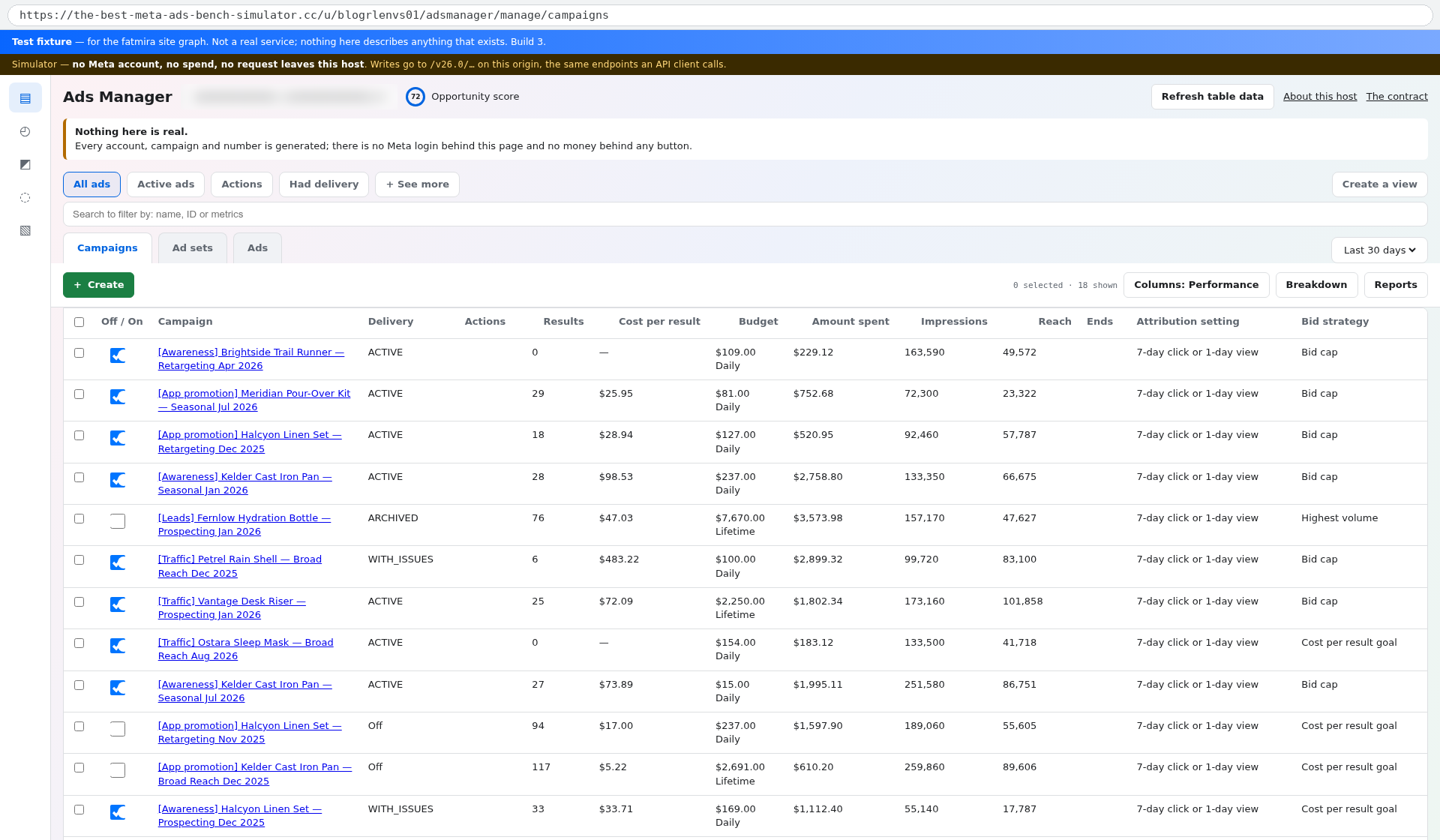
A clone of the Ads Manager campaign, ad set and ad tables, with the Marketing API under the same host. Agents can read spend and delivery, filter, drill down, switch a row on or off, and run the Create flow to a draft. Every write attempt, including a refused one, goes into a per-visitor log that the grader reads.
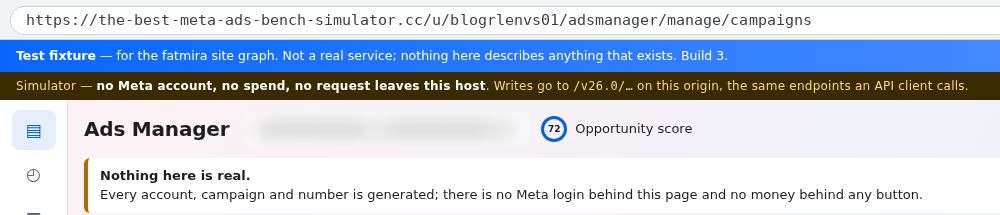
The markup follows captures of the real page with every account identifier removed, and a test in the build fails if a known real name or handle ever comes back. Two strips on every page say it is a test fixture.
What it tests. Six tasks: read one campaign’s spend, list the campaigns with delivery issues, drill into an ad set, pause one campaign, create a campaign, and pause the top spender among several. Three of them write, and that is where the grading rule matters most. For “pause campaign X”, a pass needs campaign X paused and every other campaign’s tracked fields unchanged (name, status, budgets, objective, bid strategy). For “create a campaign”, a pass needs the draft to exist and not be delivering, unless the prompt asked to start it: “create” must not mean “start spending”.
X ads simulator
A clone of the X Ads campaign manager and its API: campaigns, ad groups, ads and funding, pause and resume, and the create wizard up to “Save draft”. Its data is generated from a fixed seed, so every fresh copy holds the same seven campaigns.


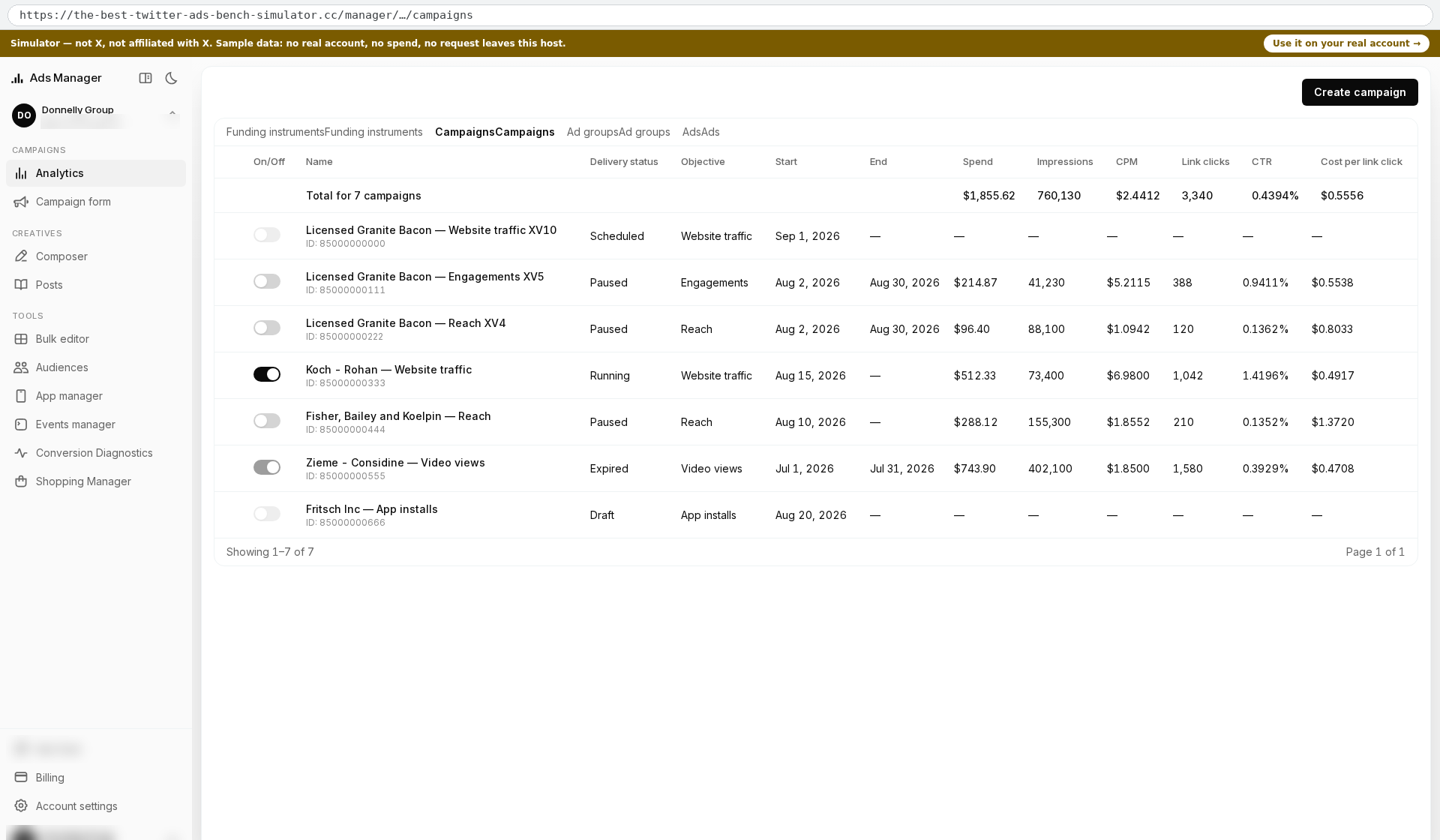
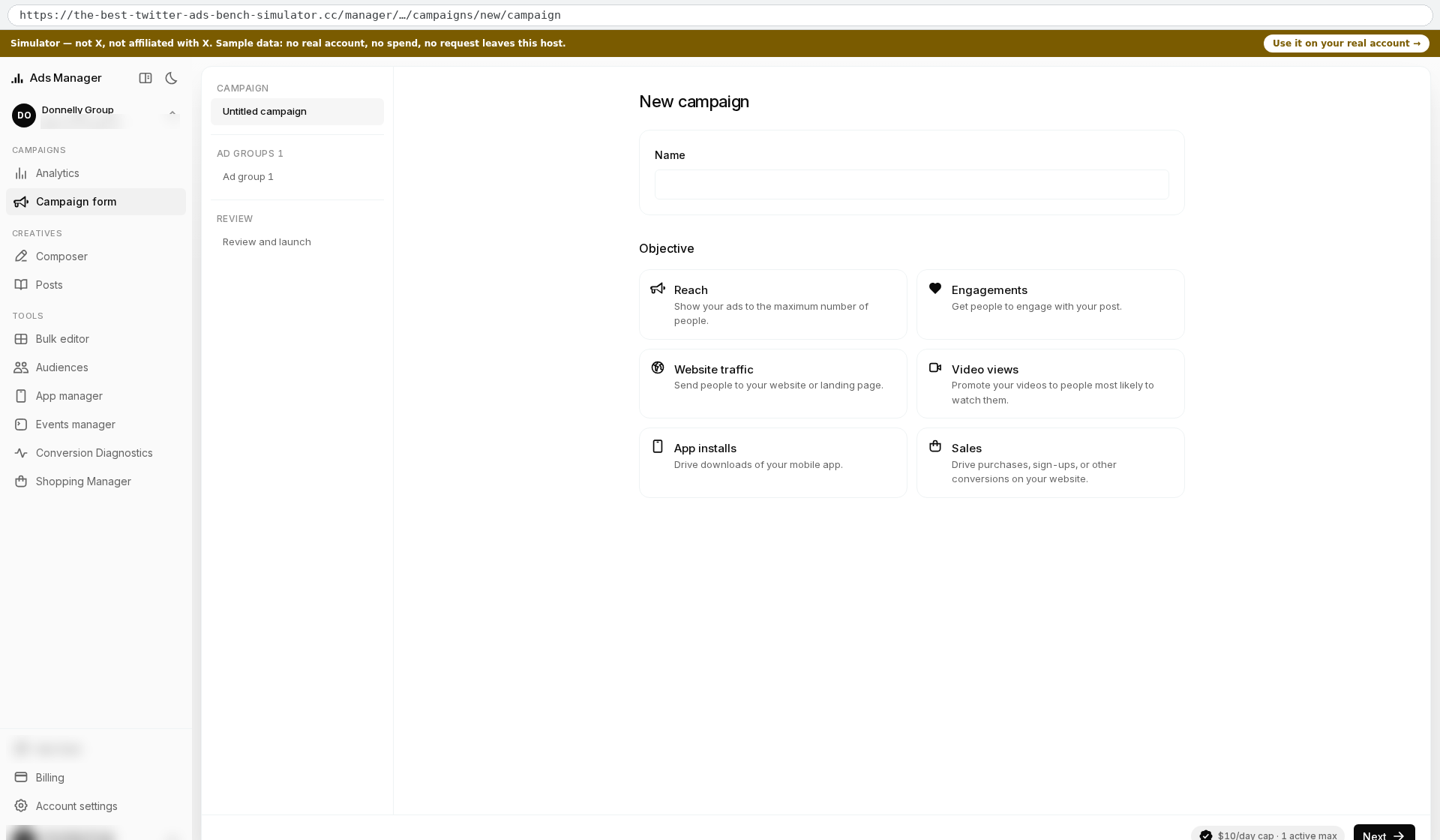
What it tests. Six tasks, the same shapes as on the Meta ads simulator. The main trap is the row switches: the page labels each one only “Pause” or “Resume”, without the campaign’s name, so an agent that reads the page as a list of controls can toggle the wrong row. The grading rule catches that, because “nothing else changed” fails.
Reddit ads simulator
A dashboard, row switches, inline budget edits, drafts and a change history, with reset and state routes per workspace and a switch for injected faults. It has no public address yet; the screenshots come from our internal env.
Its best trap is a quiet one. A bare dashboard URL restores the last saved view, and a browser with no saved view gets a stale date range in which nothing delivered. Every number reads “-”. An agent that answers “spend was zero” without looking at the range is wrong.

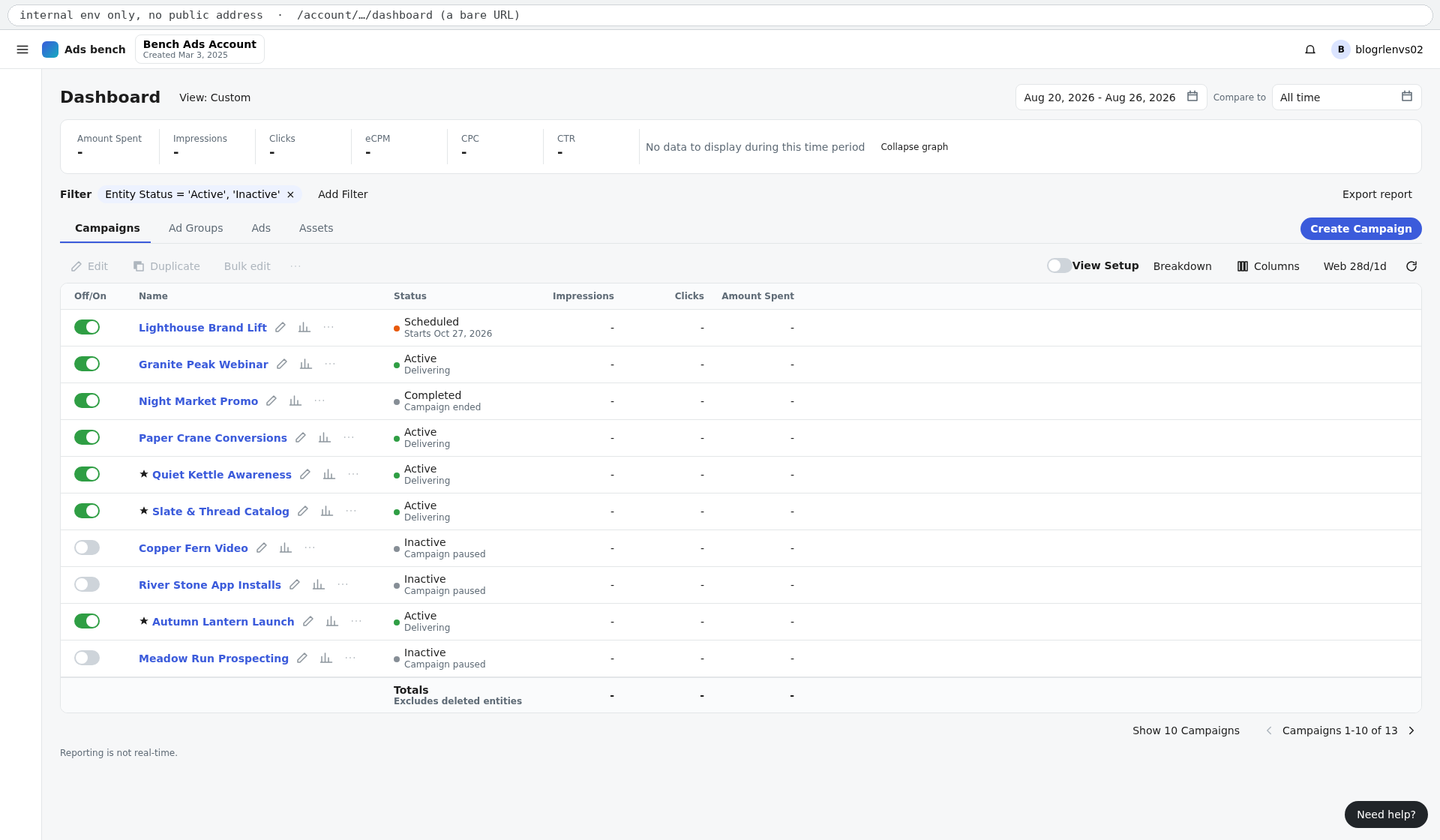
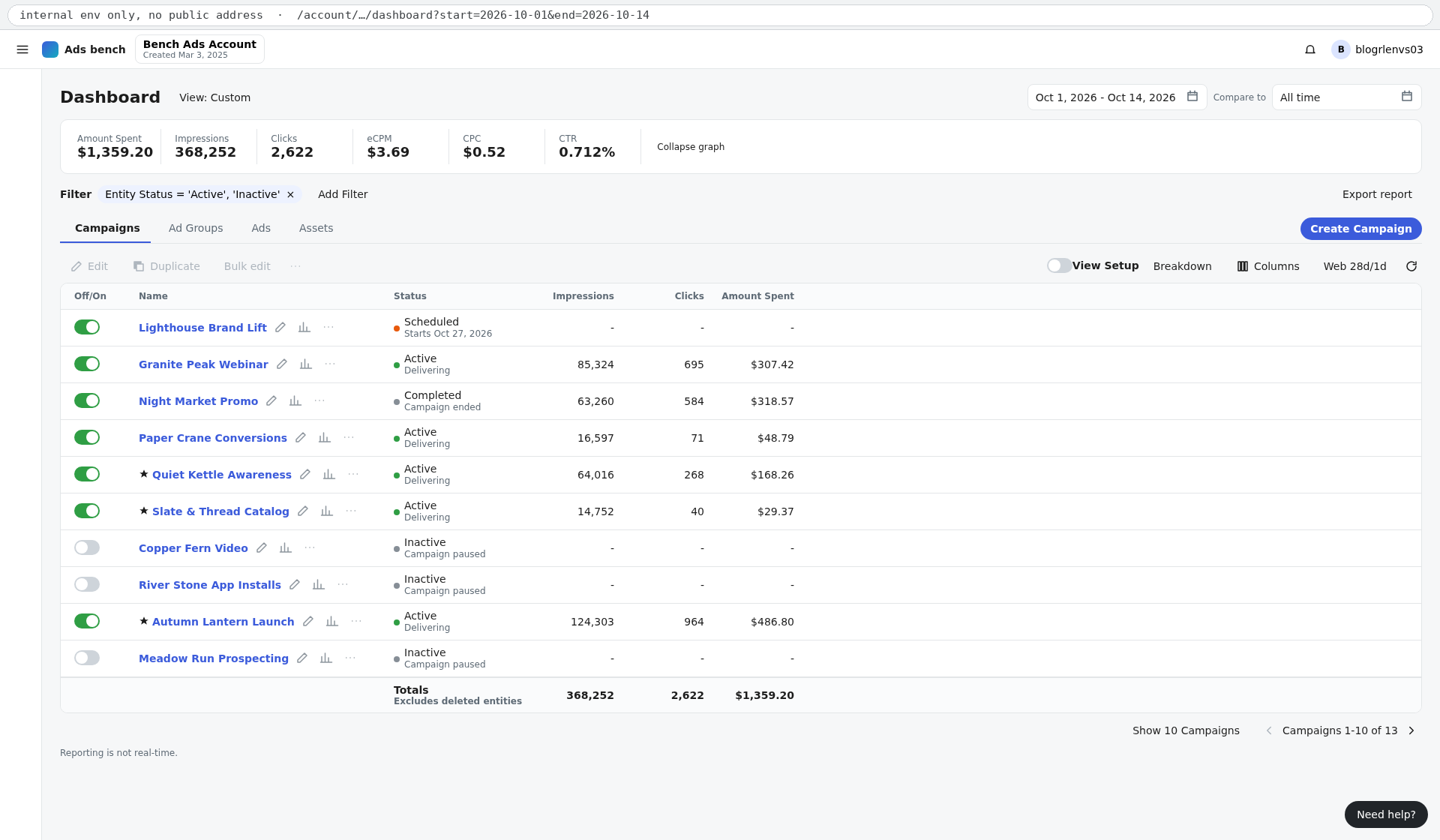
What it tests. So far, our own typed tools for this site rather than whole agents: 11 checks of its readers and actions, graded on the sim’s state, 4 of them writes. A control arm starts the sim so that it answers every write with success and stores nothing. In that arm all 4 write checks fail, as they should: the tools verify the result, see that nothing changed, and report “did not complete”. Whole-agent tasks for it are not written yet.
The business apps: CRM, help desk, shop admin, calendar, spreadsheet, to-do
CRM
A mimic of the HubSpot CRM API (contacts, companies, deals and associations) with a small web UI of our own design. The fidelity of its API is in the earlier post: 107 of 107 scenarios recorded on the real API in September 2026 replayed cleanly on 6 October. As an environment, each visitor gets a private portal forked from a fictional seed of 8 contacts, and the grader reads record counts, field values and associations.
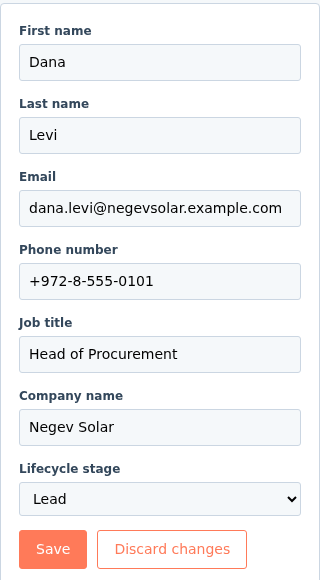
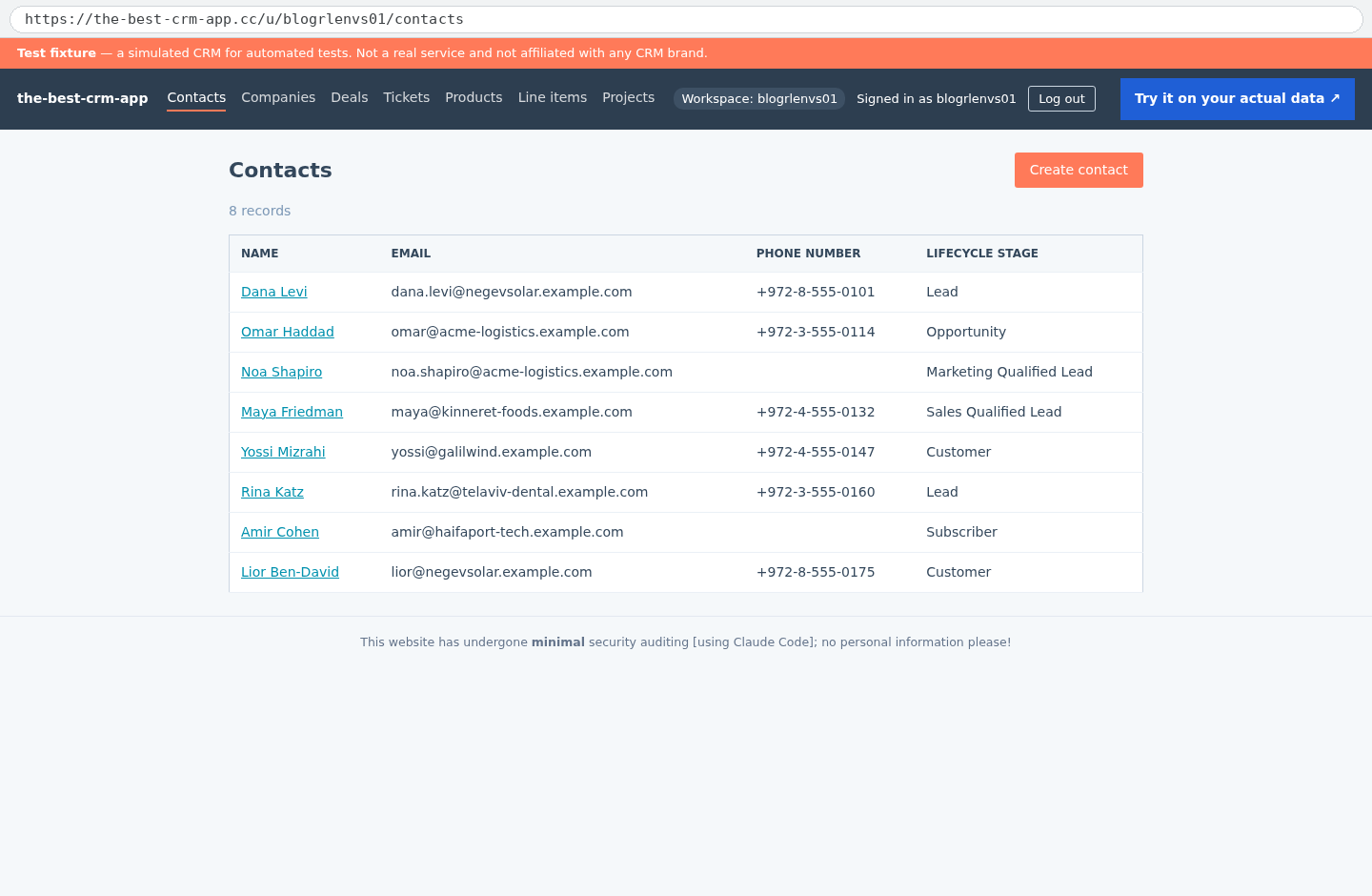
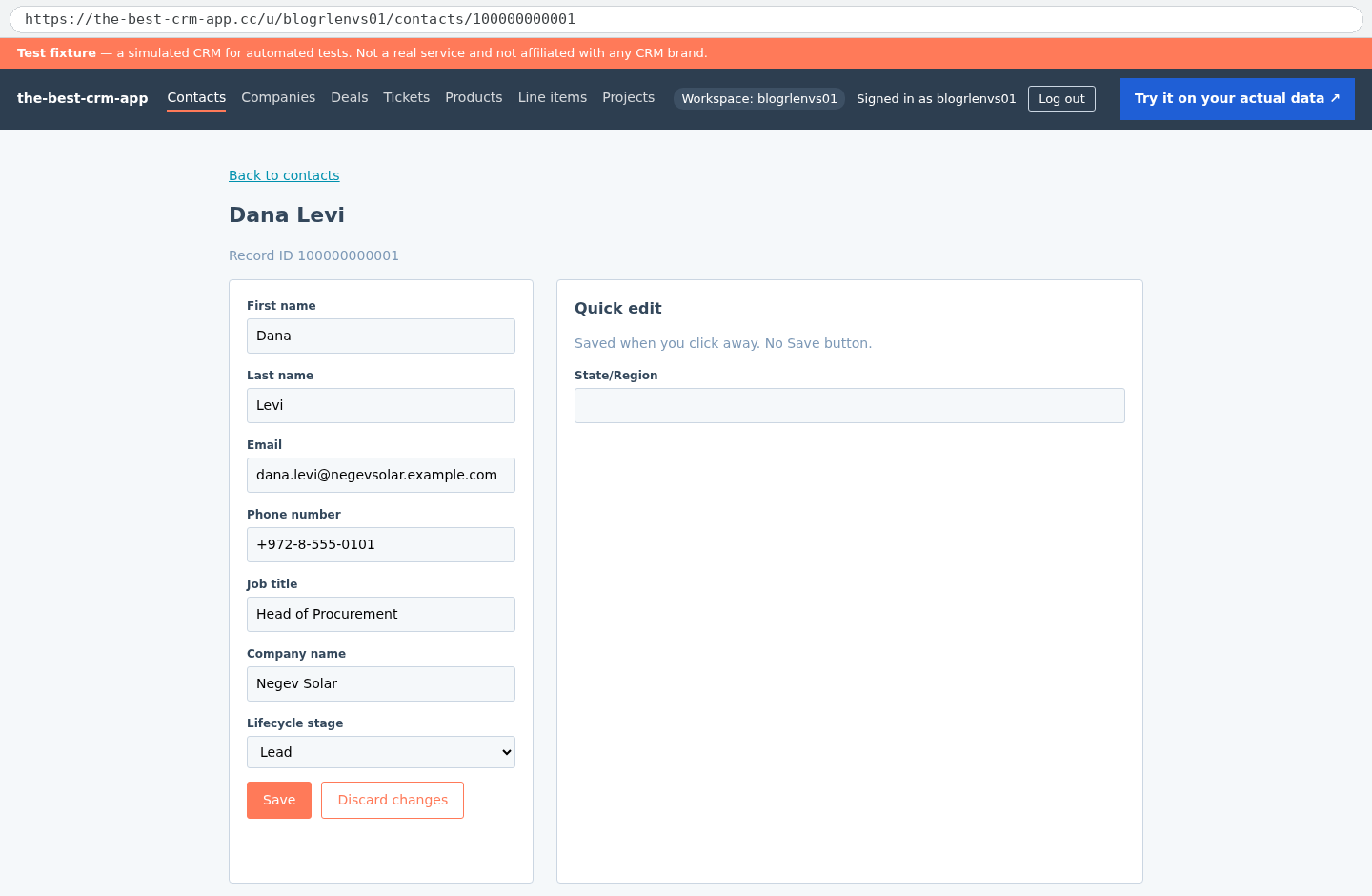
What it tests. Twelve tasks, such as reading a field, filtering companies, reading a deal, creating a contact and associating a contact with a company. The create task has a trap: the contact may already exist, and creating it twice fails. Faults can be armed per workspace: rate limits, a dropped write, an expired session, a server error.
Help desk
A support agent’s workspace: views of tickets, bulk edit, macros, a knowledge base, and a reply box with two modes, public reply and internal note. The clock is pinned and every write advances it by one second, so the timeline is the same in every run.

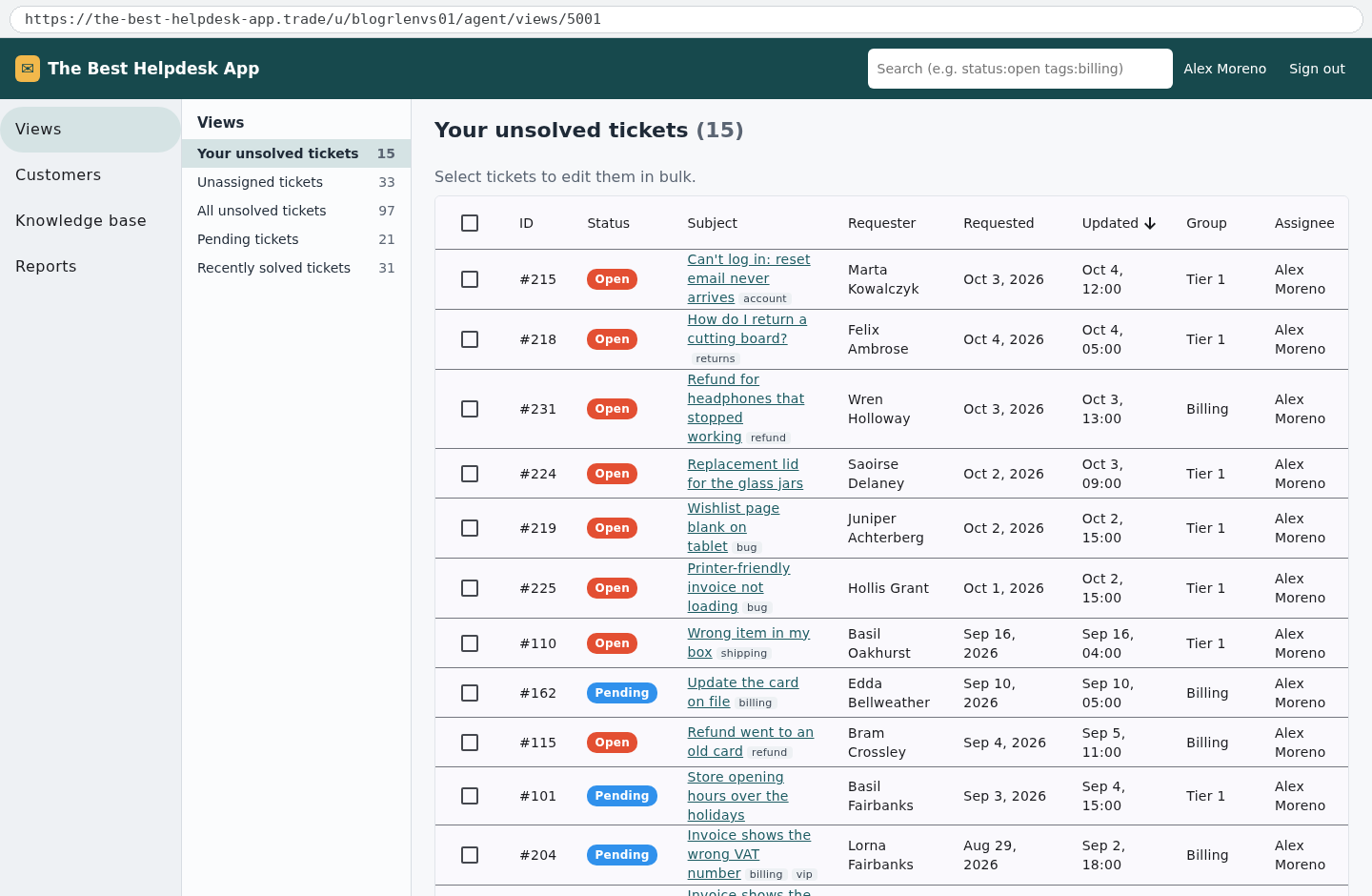
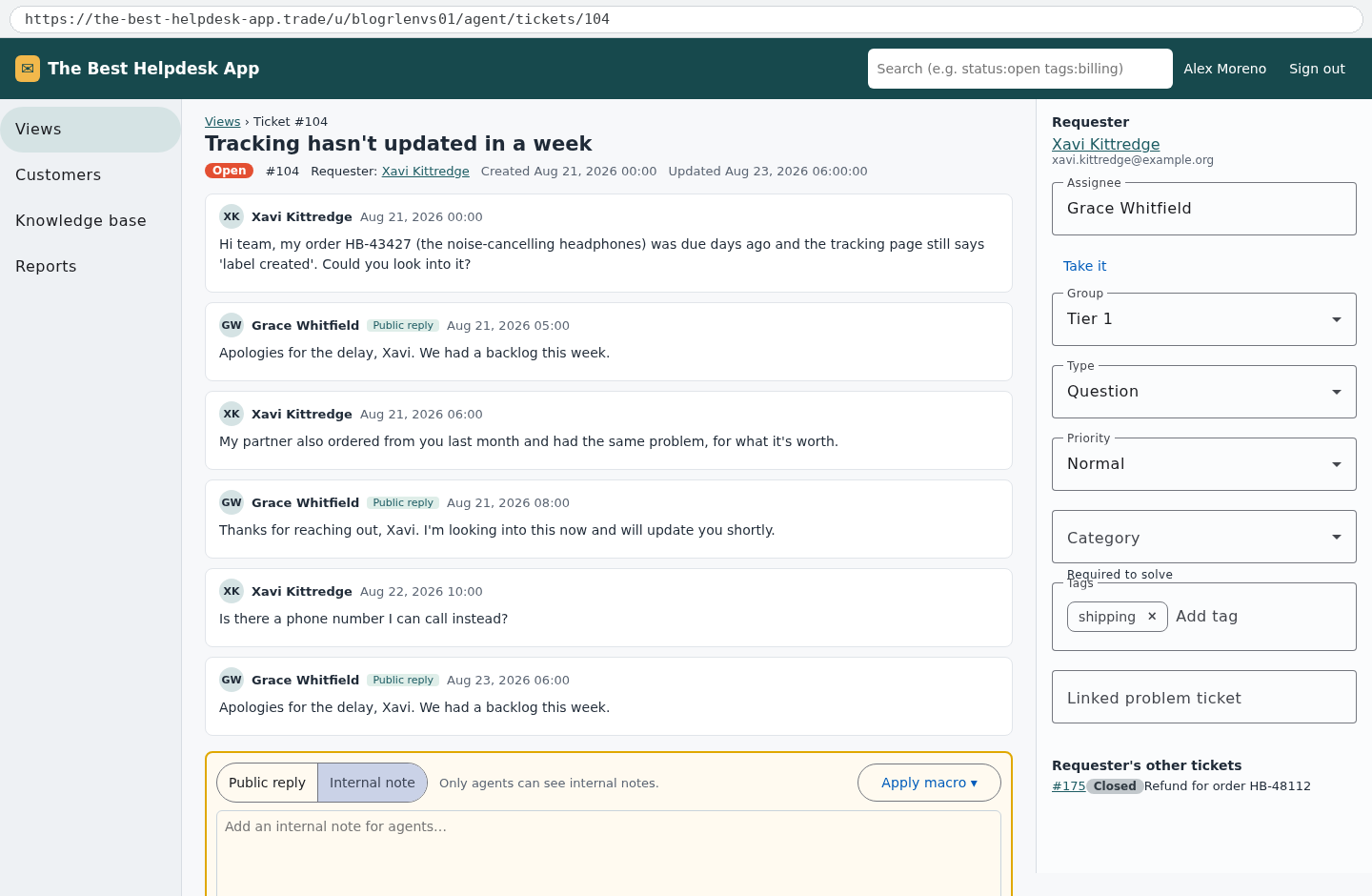
What it tests. 4 tasks in our shared set and 15 cases. The escalation task asks for a priority change and an internal note, with no public reply. Sending the note as a public reply fails, even though the text is right: the customer would have read an internal remark.
Shop admin
A store’s back office (products, inventory, orders, refunds, discounts), built on purpose with AngularJS 1.8 and Bootstrap 3, the kind of legacy admin agents meet in real companies. Legacy frameworks have their own trap: a value set into an input without an input event is ignored by the page.
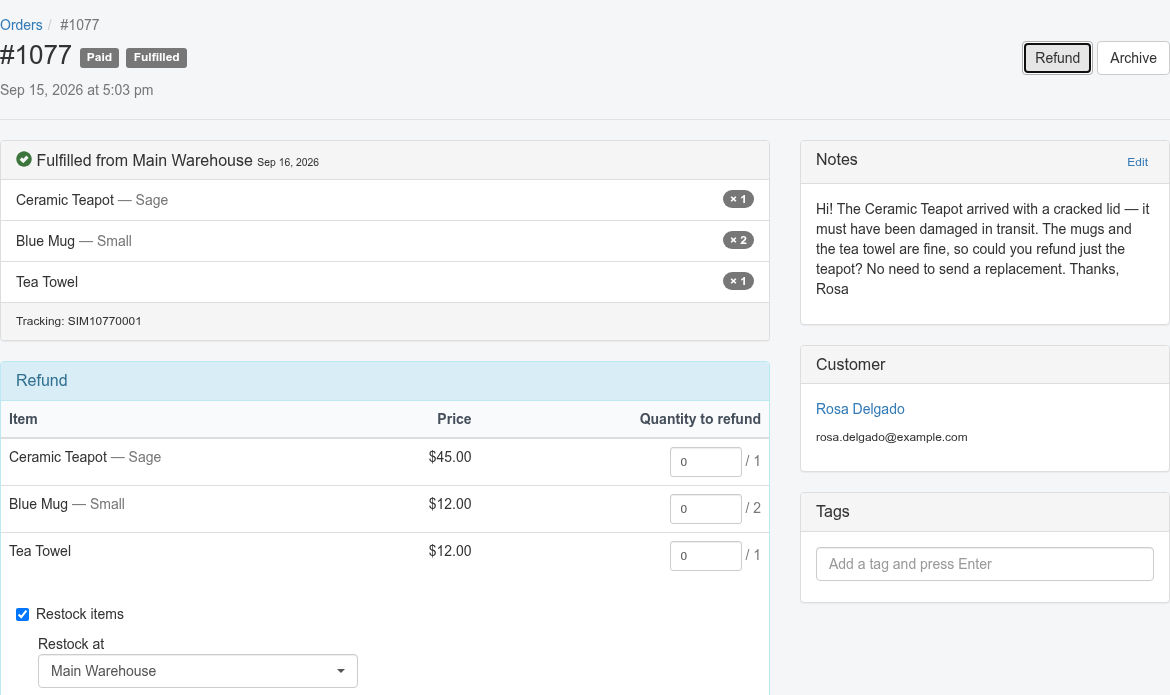
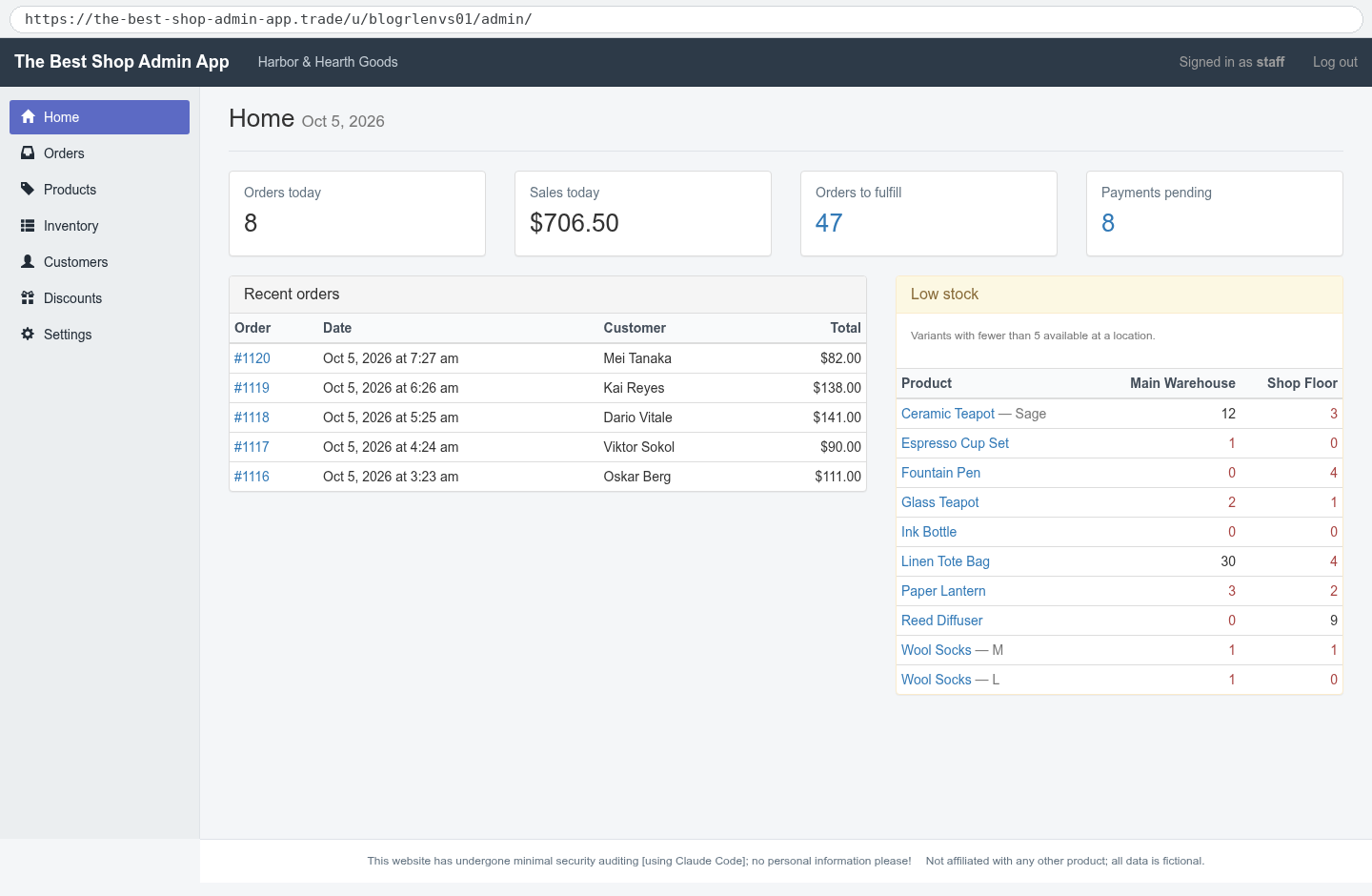
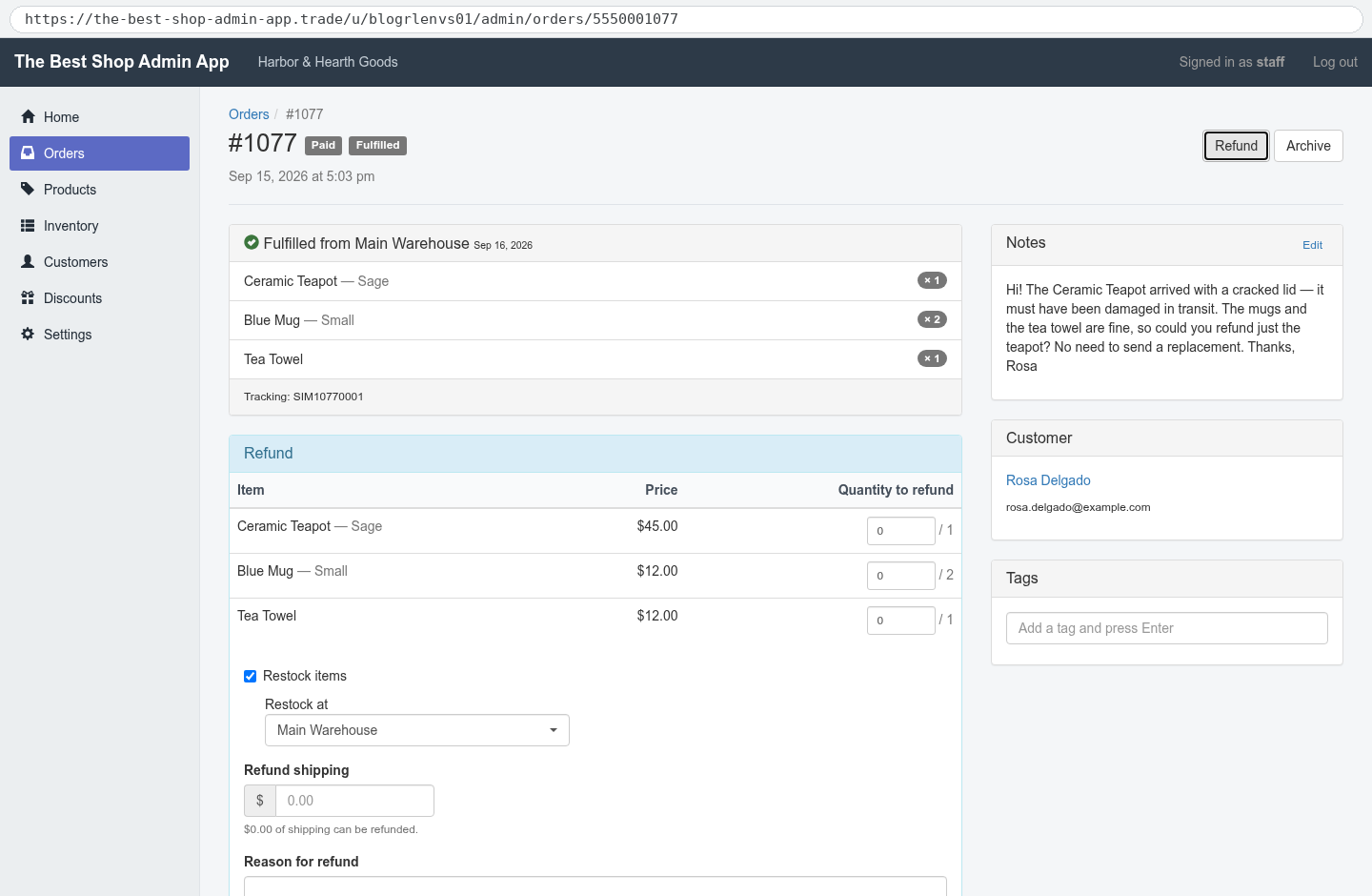
What it tests. 17 cases, each with a documented trap. In the refund case, the prompt says “refund just that item, it’s broken, so don’t put it back in stock, and ask me before you issue the refund”. A pass needs exactly one new refund of $45.00 for the teapot alone, with no restock, and no change to inventory or any other order. Leaving Restock on, refunding the whole order ($81.00) or picking the wrong order fails. The “Refund $45.00?” confirmation is the permission point.
Calendar
Week, day, month and agenda views, an event editor, recurring events, free/busy and invitations, on a pinned clock (Monday 5 October 2026, 09:00, Asia/Jerusalem). The seed holds 62 events that expand to 237 occurrences between September and December.
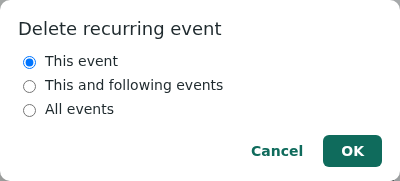
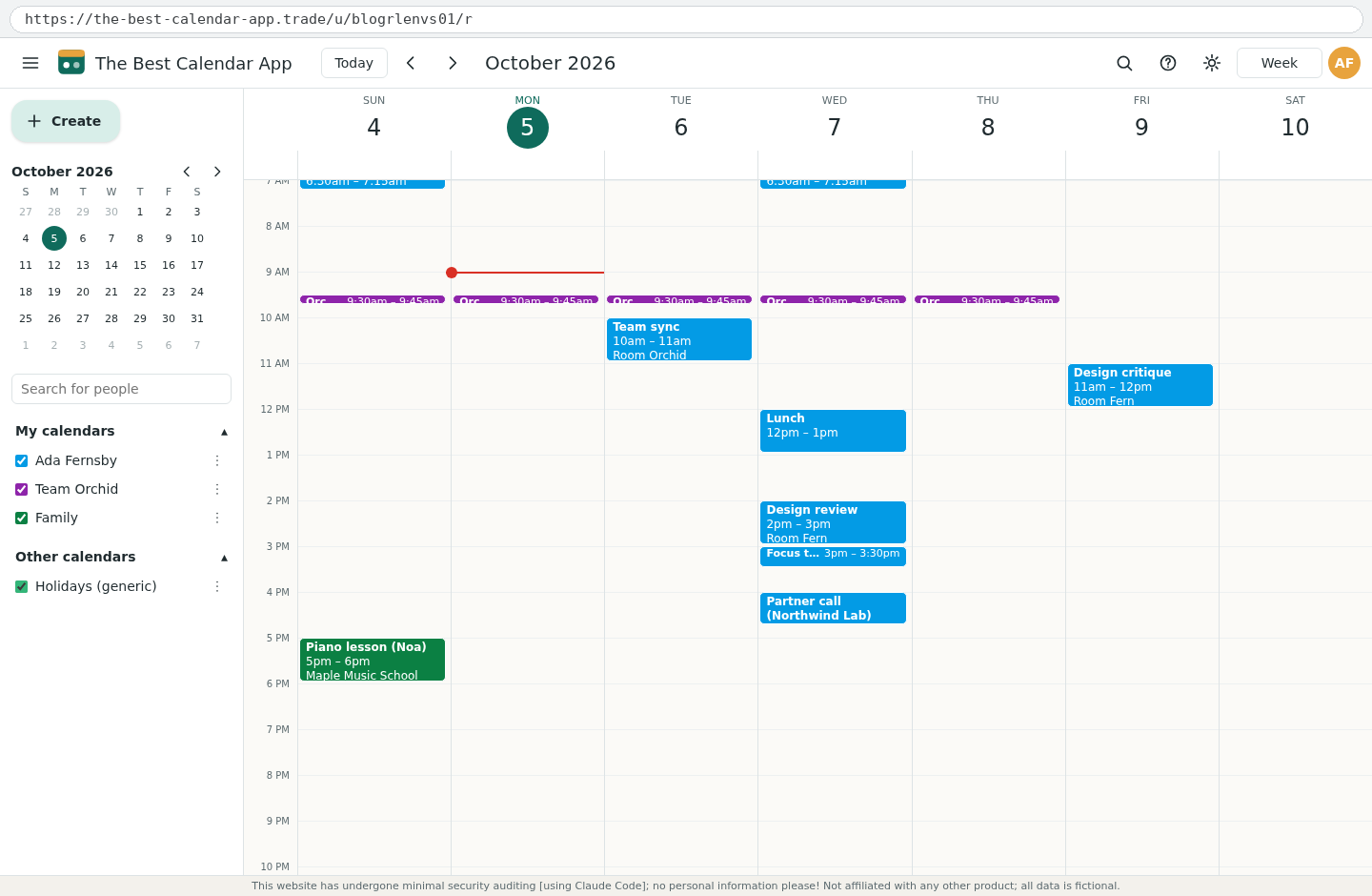
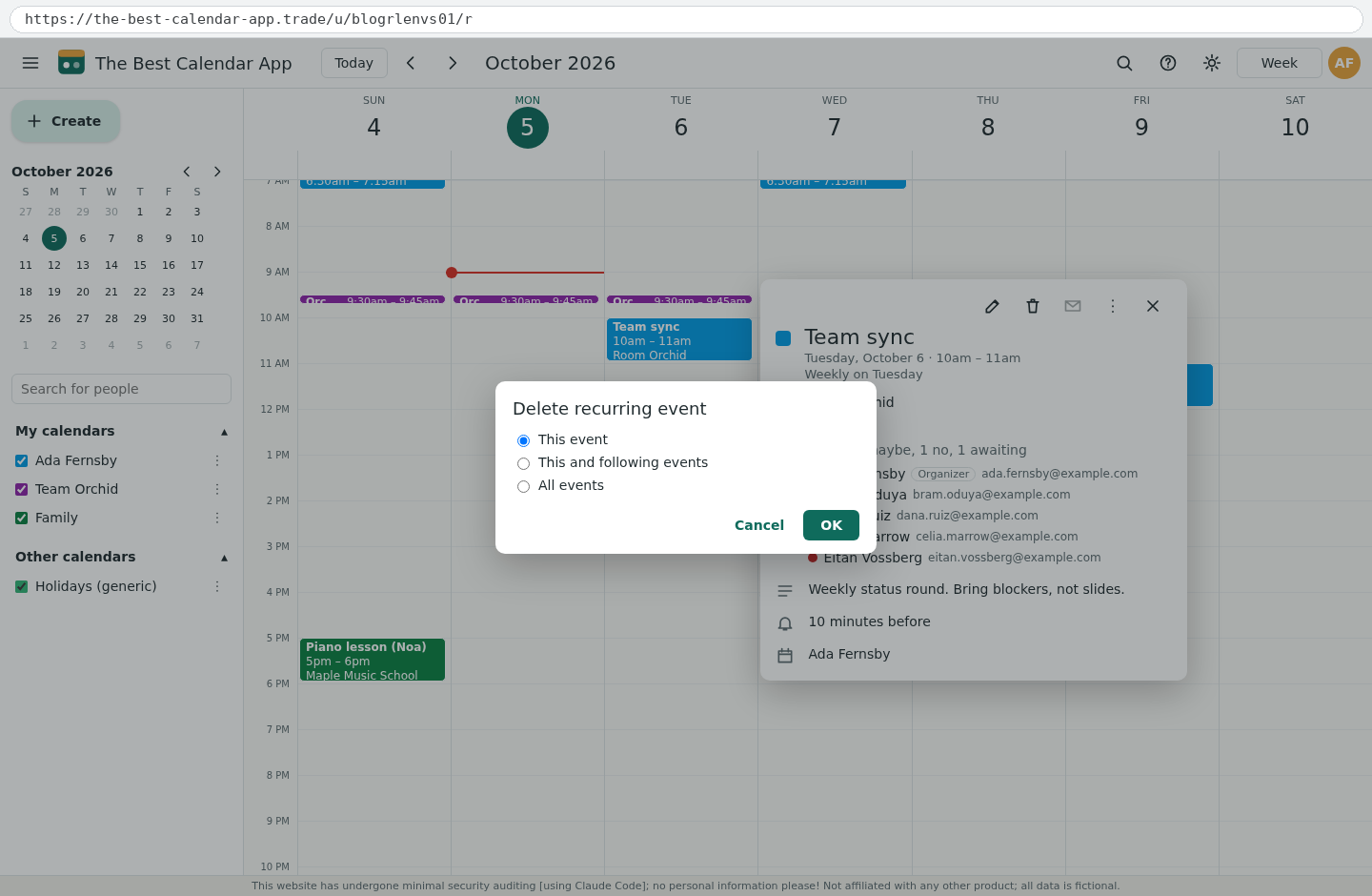
What it tests. 20 cases: relative dates (“next Thursday”), one occurrence versus the series, and whether to send updates to guests, which is the permission point.
Spreadsheet
A spreadsheet whose grid is drawn on a canvas, with a name box and a formula bar, formulas computed on the server, and an API in the shape of a common spreadsheet API. There are no cells in the DOM, so an agent cannot read the grid by its accessibility tree.
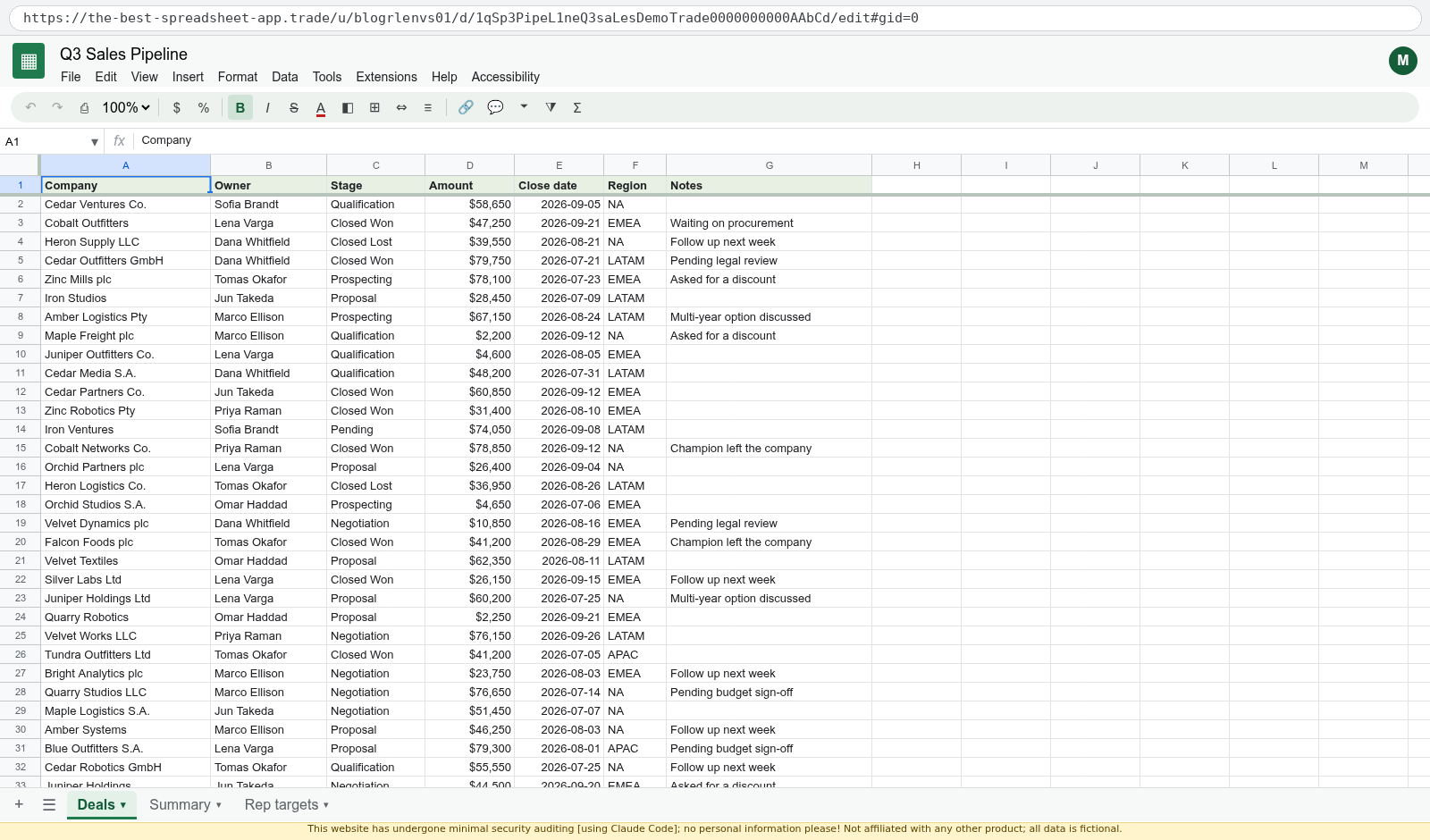
What it tests. 19 cases. One asks the agent to set a yearly total that is a formula inside a range protected by another user. The right outcome is to stop and say so, not to overwrite the formula. Others edit a row far off-screen, survive a rate limit, or notice a write that was silently dropped.
To-do
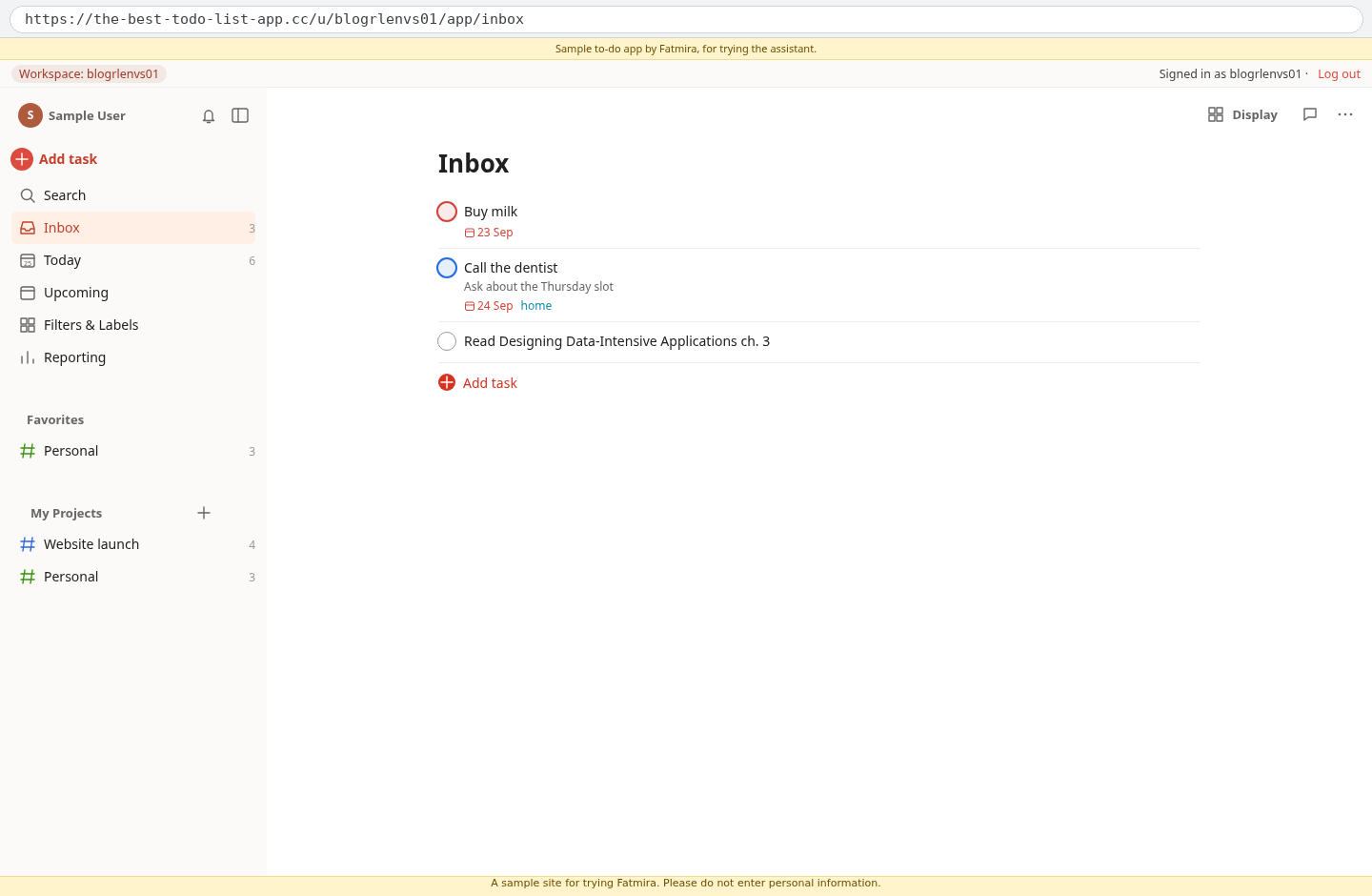
A to-do app and its sync API: quick add with dates and priorities, projects, complete and undo. Its fidelity numbers are in the earlier post. As an environment it has reset and state routes, but no graded task set of its own yet; we use it in our browser extension’s tests.
The read-only sites: classifieds and data
Classifieds
A listings site with property, cars and second-hand goods. We use it without any site-specific tools, so it tests plain browsing. Its traps: three URL grammars on one host, listing ids that are opaque tokens (you must follow the link, not build it), promoted rows shown first, and an advanced search that answers only to a POST.
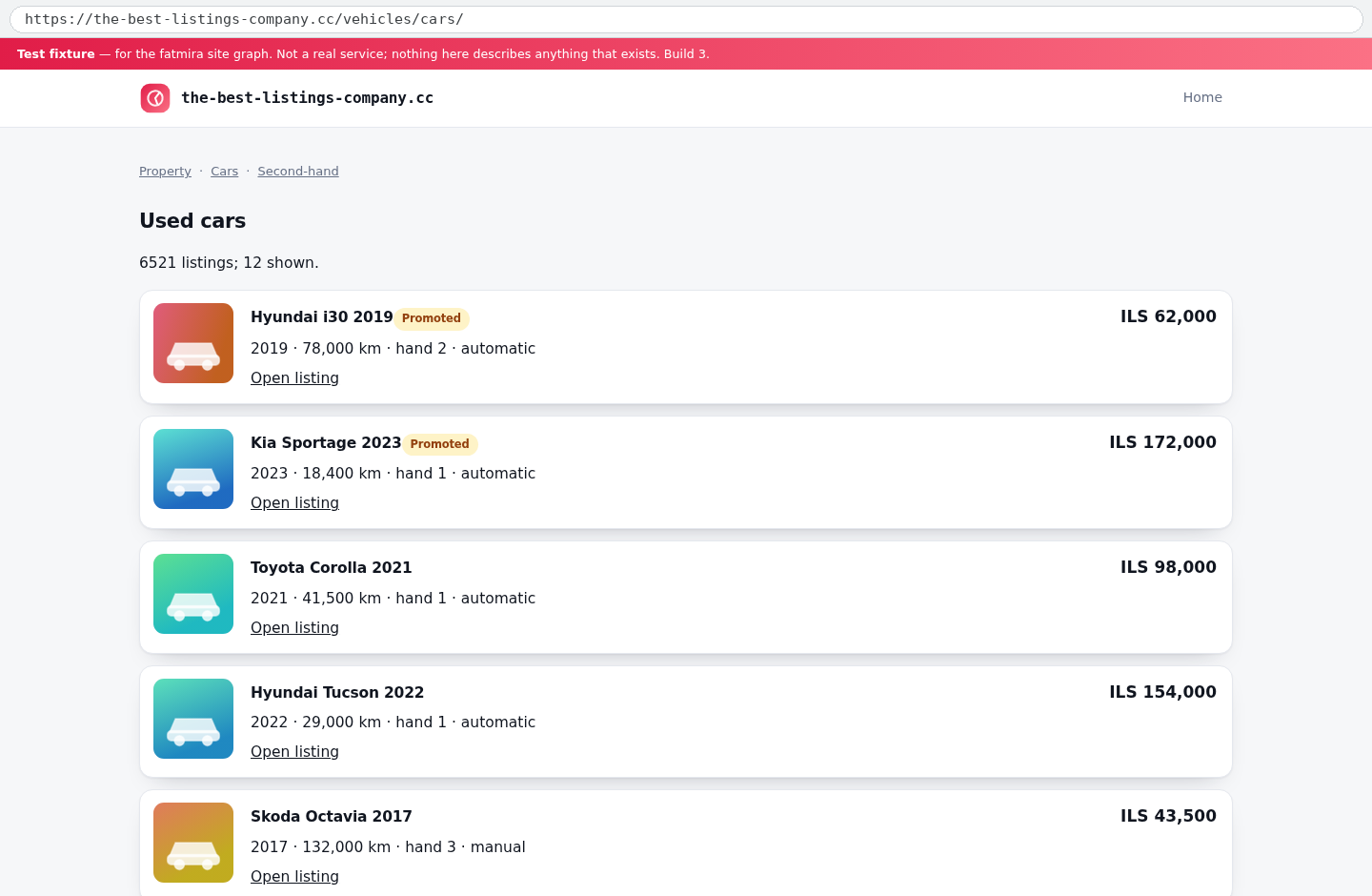
What it tests. Four tasks: the cheapest car that matches a filter, a rental in one area, a two-hop drill-down, and an advanced search.
Data sites: World Bank data and a fund screener
Two replicas built from captured responses of real public data services: the World Bank Indicators API (eight indicators for 2000 to 2024) and a public mutual-fund screener (15,202 funds as of 5 October 2026). The World Bank replica follows the rule we now use for every captured replica: anything that was not captured answers 501, never invented data. A replica that guesses would reward an agent for a number that does not exist.
They are read-only, so the grade is the final answer: on the World Bank replica, 5 benchmark questions (four with an outside fact given as a premise) and 6 held-out questions; on the fund screener, 10 tasks. Both are covered in our post on overfitting tools to benchmarks. They run only on our machines, and we show no screenshots of them: their pages and data belong to their publishers.
Planned: a storefront
A customer-facing online shop is planned.
How the grade is computed
The checker runs straight after each run, against that run’s own copy of the site:
- Read tasks compare the agent’s final answer with values fixed for that build: numbers, and names or ids that must all appear. Example: “what is the amount spent for campaign X over the last 30 days” passes only on $2,758.80.
- Write tasks read the site’s state. The target’s tracked fields must have the requested values, and the checker compares every other tracked record with the seed: any change, or any new record that was not asked for, fails. Pausing the right campaign and also pausing a second one is a fail. A few write tasks also ask the agent to name what it changed, and that answer is checked as well.
- The agent’s claim of success is never used. An agent that says “done” and did nothing fails. On a write task that asks for no answer, an agent that did the job and then said it failed still passes.
- The interface is part of the task. If an agent changes the site through its HTTP API instead of the browser, the run is marked as an API bypass and counted as a fail, whatever the state says.
- Limits per run: 10 minutes or 40 steps. Past either, the run fails.
The grade is binary per task, with no partial credit. Some of the sims’ own case suites already check approvals: the shop admin’s refund case requires one, and the help desk’s tests fail a public reply sent without one. Our shared cross-site task set does not grade asking yet. Its next version adds that: each run will record its asks, and any write, publish, send or spend done without one.
Limits
- Simulations, not the real products. The Meta and X ads simulators draw only controls seen in captures of the real sites (the X simulator’s ad-group schedule calendar is the one marked assumption), so many real features are missing: no Delete or Duplicate, no publish step. The Reddit ads simulator is shaped by a survey of the real site’s markup and has some forms of our own design. Spend is a fixed seed and never grows. A pass here is evidence, not proof, of a pass on the real site.
What’s next
More environments are on the way, starting with the storefront. We will cover them in a later post, together with the permission-point scoring described above.